
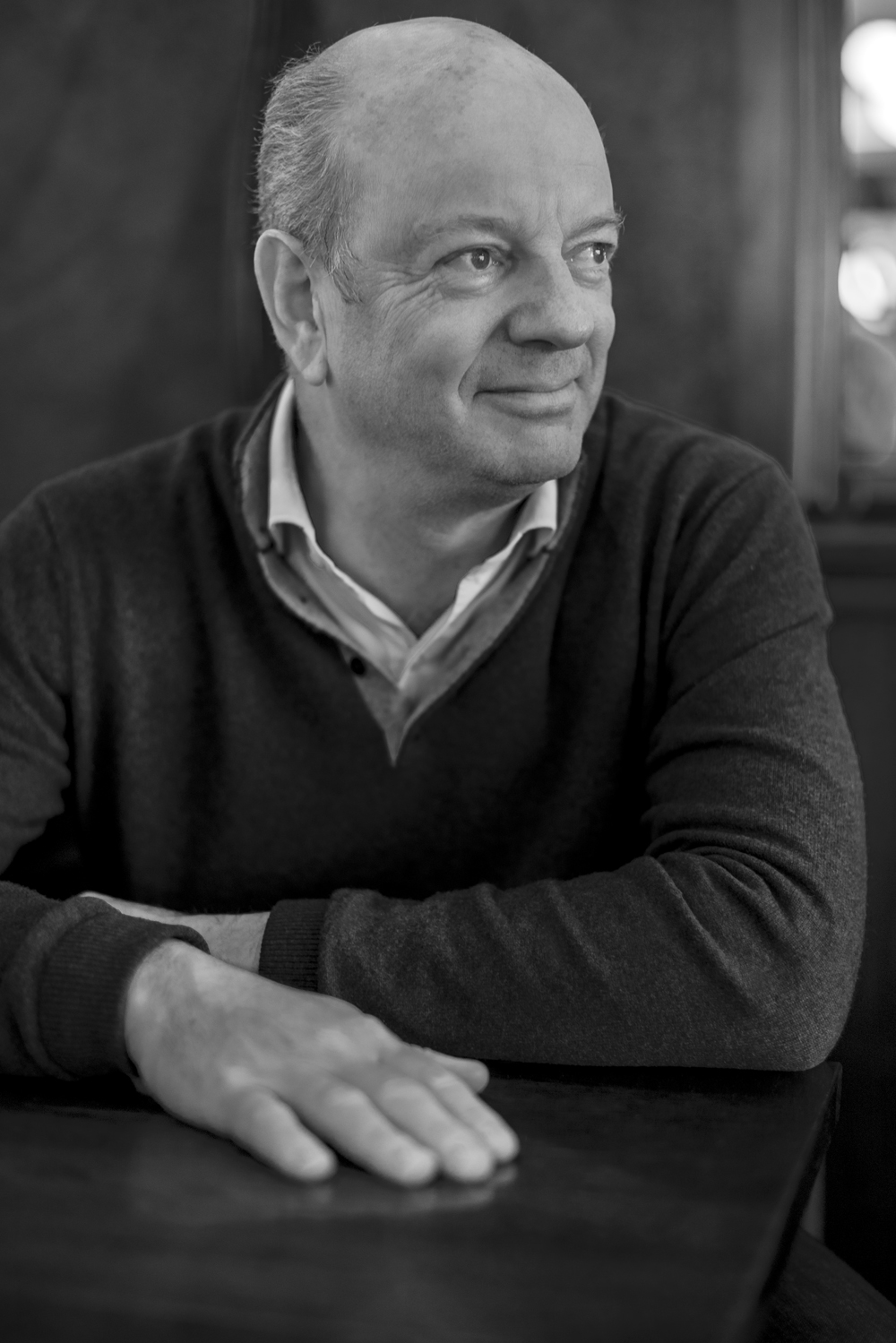
Based in Savigny-lès-Beaune, François de Nicolay is a self-taught winegrower who co-manages the family estate, Chandon de Briailles, alongside his sister Claude, while also producing négociant wines under his own name. Two distinct activities, certainly, but highly complementary…
When and how did you join the family estate?
After studying business, I quickly set up a company distributing mainly Burgundy wines. I even opened my own shop in Pigalle. Then, in 2001, my mother called me. She wanted to hand over the reins. I took a little time to think about it – ten minutes – and then I jumped in.
What was your first priority?
Training myself, to begin with. Unlike my sister, who is an oenologist, I had no formal qualifications. I learned on the job for several months while converting the estate to biodynamic farming. As early as the 1980s, our mother had anticipated the harmful effects of chemical agriculture. She had already banned herbicides and synthetic treatments in favour of practices that were more respectful of both soil and plant life. Through my work as a wine distributor, I had also been introduced to biodynamics by figures such as Anne-Claude Leflaive, Pierre Morey – then estate manager of the renowned Puligny-Montrachet domaine – and François Chidaine. These were exactly the kinds of wines I wanted to produce. My sister shared that vision, and in 2011 we obtained Demeter certification.
What does that certification involve?
In very broad terms, the Demeter specifications prohibit the use of synthetic inputs in the vineyard and require the application of at least two biodynamic preparations: horn manure and horn silica. In the cellar, chemical additives are also prohibited, with the exception of sulphites, which may be used only within limits significantly lower than those permitted in conventional winemaking. That is the framework; beyond that, each producer develops their own approach.
What are your particular choices?
I probably push things a little further than most. To combat powdery mildew, for example, we have not used sulphur since 2016. Instead, we use… skimmed milk. Our vineyard manager, François Grangé, discovered this practice in a nineteenth-century market-gardening book and suggested we trial it for two years. The results were entirely convincing. For downy mildew, however, copper remains unavoidable, although we use very small quantities thanks to the support of various plant-based treatments. More importantly, in my view, we cultivate our soils with horses. When I arrived, I hired a contractor to work plots that I knew could no longer withstand the weight of tractors. Then François Grangé – once again – suggested that we buy our own horse and manage the work ourselves. The team was enthusiastic, and with the help of Oronce de Beler from La Maison Romane, we became the owners of a Percheron horse and its ploughs. A Comtois soon joined it, followed by others. Since 2016, all of our vineyards have been worked by four horses. As a result, tractors have disappeared entirely; the only machinery we still use is a handful of very light tracked vehicles. It is physically more demanding for the team, but it was very much their choice.
And what about pruning?
Here again, Chandon de Briailles stands apart. We use Guyot pruning, but according to the Poussard method, which balances sap flow throughout the vine and helps preserve the longevity of each plant.
Biodynamic preparations, horse ploughing, pruning… all of this requires a sizeable workforce, doesn’t it?
Indeed. The estate employs fifteen full-time staff, including administration, my sister and myself. It is a large team, and we are delighted about that. The challenge, of course, is the payroll cost, which inevitably has to be reflected in the price of the wines. That is more complicated…
How do you work in the cellar?
For white wines, the process is straightforward. The grapes are manually foot-trodden in whole bunches, vertically pressed, fermented and then aged on their lees for 26 to 28 months in large vessels, either demi-muids or foudres. Red wines are more complex. We use a semi-carbonic maceration followed by a double devatting process. In practical terms, whole bunches of Pinot Noir are placed in a vat to ferment and covered with a tarpaulin – I don’t want the process to drag on. After six to eight days, intracellular fermentation is complete. Inside the berries, the flesh has turned pink and become lightly sparkling. We then carry out a first devatting, pass the cap through the destemmer, return it to the vat with the juice poured over the top, and continue vinification for a further eight days without punch-downs, using only pump-overs. A second devatting follows. This process is crucial for us. It allows us to extract the finest tannins from the stems – those released during the early stages of fermentation – while avoiding the drier, harsher tannins that emerge later. The result? Wines with greater freshness, complexity and ageing potential.
Then comes ageing…
All devatting operations are performed by gravity. At this stage, we have still not used any sulphites, so we must avoid excessive handling and minimise any risk of oxidation. For the reds, the free-run juice and press wine are blended together and transferred to the cellar in traditional 228-litre Burgundy barrels, fewer than 10% of which are new. The wines age there for 16 to 18 months before bottling. Only then do we decide whether sulphites are necessary. In recent years, they have been. Our red wines lacked sufficient acidity and needed protection, so we added sulphites at a rate of 2 g/hl – the minimum required.
Where does your négociant activity fit into all this?
It is closely linked to my previous career as a wine distributor. Rather than working on behalf of others, I wanted to work for myself, without exposing Chandon de Briailles. Many growers use their estates to produce négociant wines. I chose not to. I did not want to blur the lines between the two activities. So, around 2008, I launched my own négociant business. Beyond fulfilling a personal ambition, it became a testing ground for new ideas: my first sulphite-free experiments, longer ageing periods for white wines, bottling using a traditional two-spout filling device, and much more. Whenever an experiment proves successful, it is introduced at the family estate.
Except when it comes to buying grapes…
Of course. My minimum requirement is that growers are converting to organic farming, allowing me to support those making the transition. Not all of my suppliers practise biodynamics. Some grow grapes without making wine themselves. Otherwise, I tend to favour fruit from lesser-known appellations rather than prestigious crus. The latter are rarely available, and when they are, prices can be extraordinarily high.
You wanted to make Burgundy more accessible?
Absolutely. Through my négociant activity, I want to offer well-made, enjoyable wines at affordable prices. At the estate, that is more difficult. Aside from two Village appellations, all our wines are Premier Cru or Grand Cru, most of them red. My négociant range is the exact opposite, featuring appellations such as Bouzeron, Mâcon, Mercurey, Rully, Saint-Véran… Production totals around 45,000 bottles a year across roughly fifteen appellations, which vary according to opportunities and vintage conditions.
What about the future?
At the moment, I have no major development projects underway. Managing both the family estate and the négociant business keeps me busy enough. There is also Domaine des Moriers in Beaujolais, which I founded with a friend. One of my daughters now makes the wines there, while another is considering joining us once she has completed her studies. Beyond the day-to-day work, my main focus is transmission and succession. It is a vast subject…