
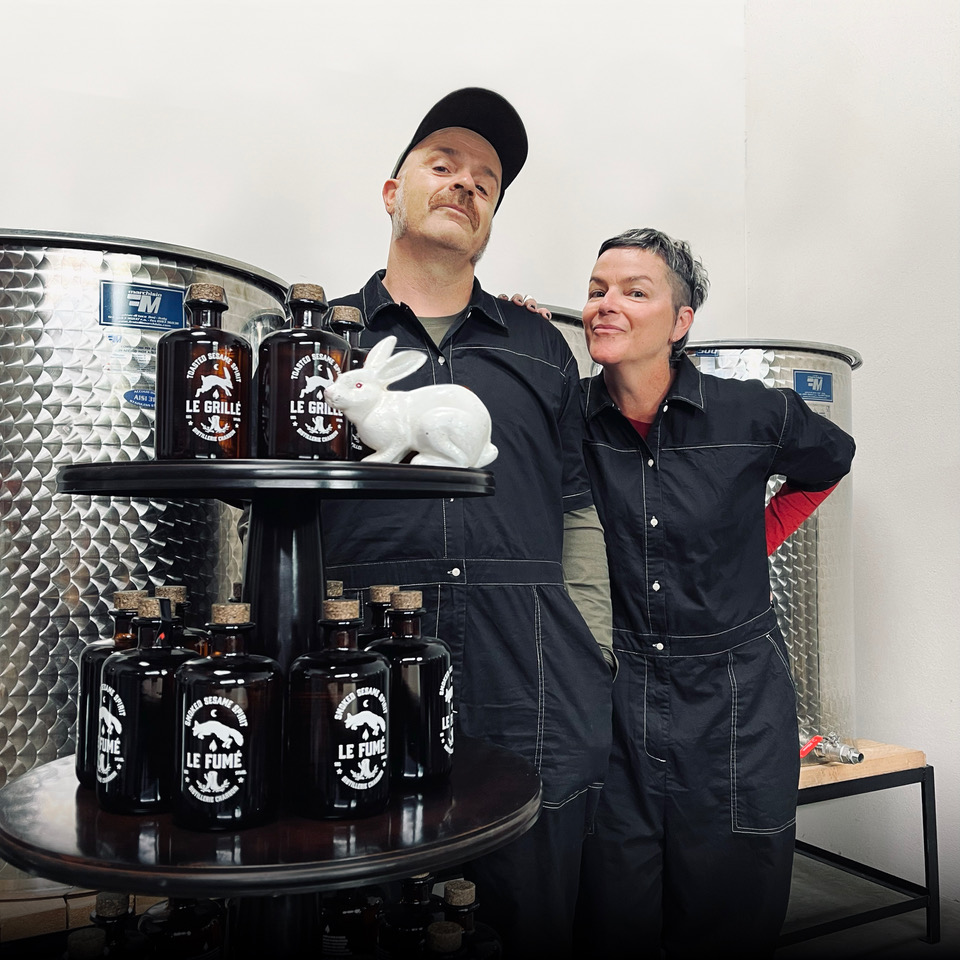
His wife suggested they should get into distilling — and he took her at her word. Together, they created the first range of sesame-based spirits, with varying levels of smokiness, paving the way for an entirely new category…
How did you move from semiotics into distillation?
I never stopped working in semiotics. Even today, I continue to study what the design of an object communicates to its users. Stéphanie is still a graphic designer too. But nearly nine years ago, during a walk through the Aubrac region, we both realised just how disconnected we had become from the natural world. We wanted to leave behind the Parisian agency scene. Creating something with our own hands became an obvious next step. Craftsmanship really resonated with us. On my side, I had the opportunity to take over my parents’ house in the Monts du Lyonnais, along with its 200-square-metre barn. And then there was our love of peated whiskies — especially their smoky notes. They reminded me of my childhood spent between Lyon and Saint-Étienne, where the smell of wood fires was ever-present. One thing led to another, and my wife suggested we set up a distillery in Saint-Symphorien-sur-Coise…
And why sesame?
It was quite a journey — and always as a couple. We began by attending weekend distillation courses near Cognac at the Centre International Des Spiritueux, the leading institution in the field. Beyond the technical skills we acquired, it allowed us to discover the world of spirits and its artisans. More importantly, it convinced us that this project was within reach — it was simply a matter of refining the idea. We wanted to work with fat because it offers a more environmentally responsible way of producing smoky spirits. Peatlands are protected in both France and Ireland, and in Scotland, more and more people are calling for greater protection there too. In that context, fat becomes incredibly useful, as it acts as a carrier for smoky flavours. The challenge then was identifying the best oil-rich plants to distil. After numerous trials in our Paris flat, using a small still on flaxseed, cashews, sunflower seeds or even peanuts, sesame ultimately stood out — by far. Once finely cracked, its fat is easy to access, and its flavours remain distinctive while absorbing smoky notes beautifully. That was exactly what we were looking for. The product itself guided us. Nothing else.
The beginning of another long journey…
It took more than seven years to develop the project, relocate to the Monts du Lyonnais, build our production facilities and launch our range of three spirits in 2024 at the Sirha: Le Grillé, Le Fumé and Le Brulé. No one had ever distilled fat before — and for good reason. These materials create several technical challenges: after a certain storage period they turn rancid; during distillation they stick to the walls of the stills; and they often make homogenising the final product difficult. Not to mention the equipment we had to invent or adapt ourselves: a Swedish mill that we electrified in order to crack the sesame without crushing it; ultra-fine sieves, down to micron level, made in-house; and weld-free roasting machines, similar to those used for polenta, to avoid build-up. Every stage came with its own set of obstacles and improvisations.
What are the main stages in producing your spirits?
First comes sourcing: organic white sesame from North Africa — the closest supply we could find. Then the grains are cracked in the mill, taking care not to grind them. After that comes a more culinary phase: roasting, smoking, or both, depending on whether we are making Le Grillé, Le Brulé or Le Fumé. Finally, we macerate the sesame before distilling it. There is an additional step for our two latest releases, Le Sucré and Le Flambé. Sugar cane and water are added to Le Grillé for one, and Le Brulé for the other, creating liqueurs that are lower in alcohol and more approachable.
Do you experiment with ageing?
It’s complex. For now, our spirits are aged for just a few months in stainless steel tanks. Initially, we tried barrels, but research carried out with the R&D teams at the cooperage Seguin Moreau revealed exchanges that were simply too intense — we ended up with what tasted like pure wood extract. Amphorae weren’t any better either, as the fat clogged the pores. But we haven’t given up. There are still avenues worth exploring.
You mentioned sourcing organic sesame. Are there other practices that reflect your sustainability commitments?
Many, in fact. The water used to cool the alcoholic vapours operates in a closed-loop system, which saves more than a thousand litres per distillation. Our still is designed for low electricity consumption. All our dry residues are repurposed too: the Japanese restaurateur from a nearby village turns them into gomasio, while a local workshop is planning to use them in cookies. The vinasse is sent to a nearby methanisation plant, where it is transformed into fuel for public transport. Nothing goes to waste. Even our bottles are produced just a few kilometres away, and we operate a local bottle return scheme. The remaining challenge is sourcing. We hope sesame cultivation will continue to develop in France. It’s beginning slowly in regions where vineyards are being uprooted — particularly in the Drôme — and, from what we hear, around Bordeaux as well.
You’ve been selling your spirits for nearly two years now. How have customers responded? What do they appreciate most about the range?
In the kitchen, the applications are endless. César Troisgros, chef at the three-Michelin-starred Le Bois sans Feuilles, recently created a soufflé using our Le Grillé. A Breton restaurant uses our liqueurs to flambé crêpes. Others pair them with chocolate desserts or apricot sorbet in reinterpretations of the classic trou normand. In mixology, beyond the sesame flavour itself, our greatest strength is the richness of the spirit. It softens acidic or bitter notes in cocktails while adding texture and remarkable length on the palate. Take 40ml of Le Sucré, add 120ml of tonic, and the sesame notes remain beautifully present while the bitterness of the mixer is kept in check. Many Asian fusion restaurants also favour our liqueurs as digestifs after dinner. Sesame is hugely popular across Asia, which opens up exciting export opportunities for us. Nothing has materialised just yet, but we’re working on it.
What’s next for Distillerie Charbon?
We have plenty of ideas for new recipes, but our distributors advised us to pause for now and focus on establishing the existing range. In today’s climate, that alone is no small achievement. We currently produce and sell around 300 bottles a month, but the goal is to triple that figure. Our production facilities can support it, and the interest surrounding our spirits is extremely encouraging. They offer immediate pleasure without overcomplication. You understand them instantly on the palate. It’s enjoyable, approachable and deeply satisfying. As you may have gathered, I’m campaigning for rich spirits — and hoping others will follow our lead.