
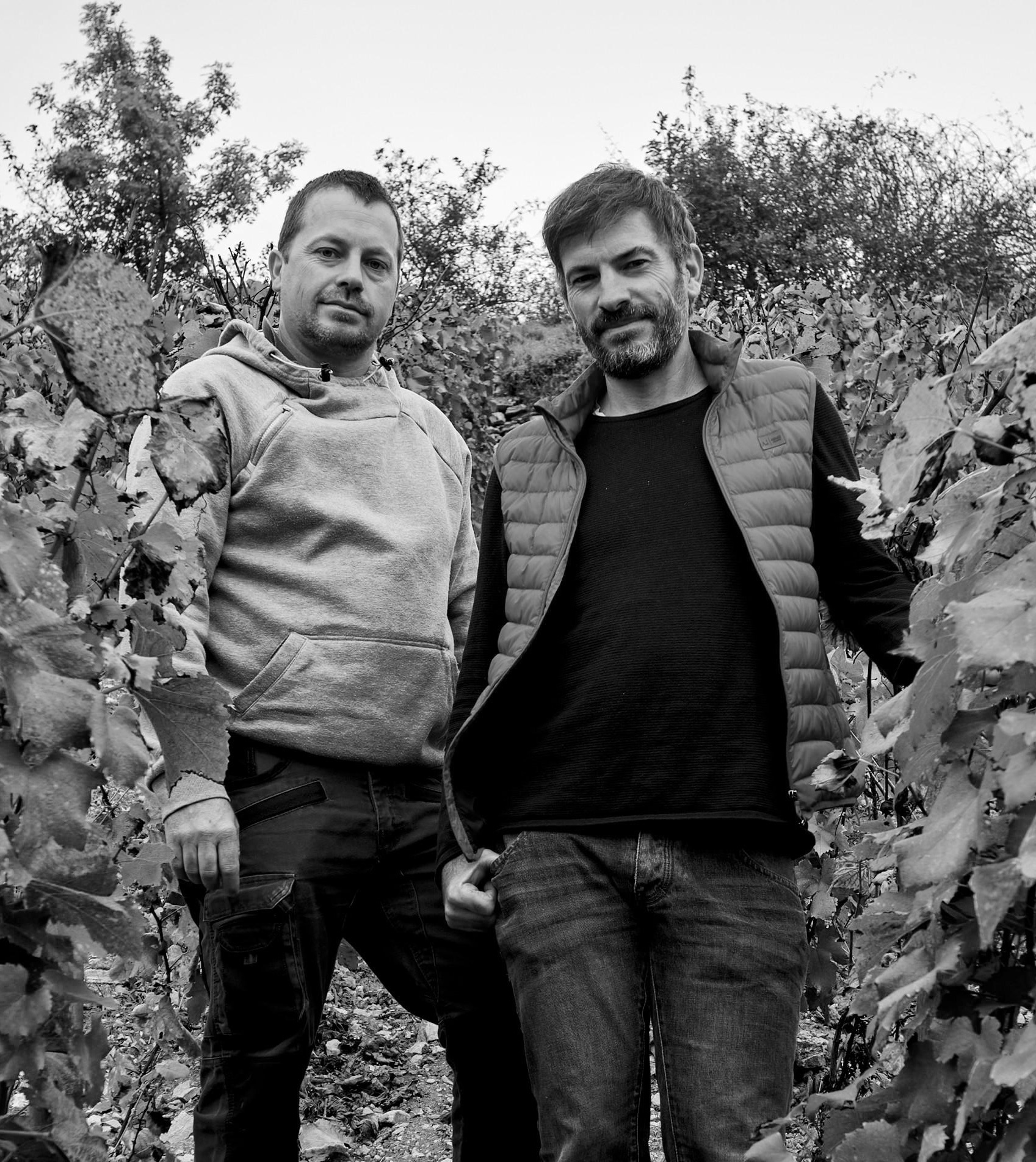
Organic and biodynamic conversion, parcel-by-parcel vinification, shorter ageing periods… One after another, the two brothers discuss the major projects they have undertaken since taking over their father Jean-Claude Bachelet’s estate in Saint-Aubin. Between the lines, a deep respect for their elders, their peers, and the vines themselves… Moving—right down to the remarkable harmony they share.
You’re running a centuries-old estate…
J.-B.: The first traces of the estate within our family date back to 1620. The vines belonged to a certain… Pierre Bachelet!
B.: They were mostly located in Chassagne-Montrachet. It wasn’t until the early 1900s that our family settled in Saint-Aubin. And yet, when our father took over the 7–8 hectare estate in 1965 after our grandfather passed away, more than half was planted with Pinot Noir. We still had, for instance, Puligny-Montrachet and Chassagne-Montrachet Premier Cru “Les Macherelles” in red. Not to mention some Gamay parcels! Chardonnay was the minority variety.
What did vineyard work look like back then?
B.: Everything was still done with horses. We had one—rather lazy, according to the rumors! Luckily for our father, he was one of the first to bring a straddle tractor to the village. He was passionate about mechanics and electricity. To the point where one might wonder whether he was really meant for the vineyard: he was only 19 when he inherited the estate…
J.-B.: And he had just one employee! So, inevitably, he had to rely on chemical herbicides—there was no real alternative at the time.
And what about you?
B.: I arrived in 2000, at the age of 20, just after my viticulture studies.
J.-B.: And I joined five years later.
B.: We grew up with the estate. Our preschool was the vineyard. It was obvious we would come back. Our father needed us. He had taken on the bottling transition all by himself, and was deeply involved in village life… He had given so much. As for me, I wanted to learn the craft at his side, share in his experience, finally move from theory to practice—while knowing that my brother and I would eventually bring our own ideas.
J.-B.: Our father has always been very open-minded.
What were your first major projects?
B.: During my internships, including one at Domaine Leflaive—one of the pioneers of biodynamics—I discovered another approach to organic farming, far removed from the “flower child” cliché…
J.-B.: Proof that organic viticulture doesn’t mean unkempt vineyards.
B.: So, in the early 2000s, we eliminated chemical herbicides.
J.-B.: And with my brother at the estate, my father had one extra person to handle ploughing.
B.: Building on this momentum, in 2012 we began our first organic trials on a few parcels. My brother and I are fairly rational… And honestly, we must have already been quite convinced, since the parcels we chose were our Bienvenues-Bâtard-Montrachet and our Chassagne-Montrachet Premier Cru “Blanchot-Dessus”, our two most prestigious appellations.
J.-B.: Still, it felt important to move step by step. We wanted to be sure we could manage the transition and control disease pressure across the whole estate.
B.: So we surrounded ourselves with good support. We didn’t embark on this journey alone. Our winemaker friends Thibault Morey and Benoît Moreau joined us—each on his own estate, but together in terms of sharing ideas, advice… We also invested in equipment, because effective tools do exist.
J.-B.: For instance, together with Faupin we developed a prototype crawler tractor with spray booms as efficient as those on a straddle tractor. We adopted a small mower tractor too, to pass between rows without damaging the vines and to keep winter grass cover under control.
B.: Without all this equipment, we never could have converted the entire estate to organic farming in 2016, and obtained certification in 2023. It’s been beneficial for the vines and the wines, of course, but also for our team and for ourselves. You develop a real sense of pride. The value you assign to your work changes.
You mentioned the benefits for the vines and the wines—what have you observed?
B.: The vines have become more balanced. They’re less dependent on the vintage. Take our Saint-Aubin Premier Cru “En Remilly” or Chassagne-Montrachet Premier Cru “La Boudriotte”—organic farming has stabilized yields that used to be excessively high.
J.-B.: A direct effect of ploughing, in my opinion.
B.: As for the wines, their balance has improved. They are more precise…
J.-B.: Perhaps less immediately flattering, but more complex.
And what did certification bring you?
B.: Proof that we’re fully aligned with what we tell our clients. It’s not just talk—it’s verified practice. To me, it’s a form of honesty toward them and toward ourselves.
J.-B.: Beyond that, as the certifiers pointed out, the more winemakers take this step, the more others follow. It creates momentum.
From there, biodynamics was the next step…
B.: For us, doing organic without biodynamics was unthinkable. It’s just common sense.
J.-B.: Nowadays, you can go organic without having a deep respect for the plant—without trying to strengthen its natural defenses. That’s not how we see things. The vine isn’t a production tool but a living being. Respect it is essential. Biodynamics extends organic farming in a logical way.
B.: So we work with the lunar calendar, fruit days, root days, cow horns, herbal teas…
Yet some scientists question the validity of these practices…
J.-B.: That’s not what we observe. Why would the same wine be clear one day and cloudy the next? There must be an external influence…
B.: Just look at the brightness on a full moon night—it’s impressive! Why would the vine be affected by that?
Today the estate has grown, and it focuses more on white wines. That must have meant planting or replanting quite a bit…
B.: Across Saint-Aubin, Chassagne-Montrachet, and Puligny-Montrachet, we now farm 10.5 hectares, producing an average of 40,000 bottles a year across 20 appellations, 16 of them white. So yes, there have been some acquisitions—particularly in Saint-Aubin Premier Cru “Les Murgers des Dents de Chien” and Chassagne-Montrachet Premier Cru “La Boudriotte”. But we’ve mostly planted or replanted Chardonnay, sometimes replacing Pinot Noir.
Which rootstocks did you choose?
B.: Like many others, we were affected by rootstock 161.
J.-B.: It was considered the most qualitative and versatile at the time.
B.: For the past eight years, we’ve gradually replaced it—part with clonal selections, part with massal, ATVB selections—while doing everything possible to preserve our nearly century-old vines. They were planted by our great-grandfather! It’s our family’s history.
J.-B.: You don’t uproot a piece of heritage. Strangely enough, we’re more attached to vines we didn’t plant ourselves…
And in the cellar—what have you focused on?
B.: Separating the cuvées! Our father, for instance, used to blend his Chassagne-Montrachet Premiers Crus into a Village wine. We wanted to showcase each terroir. At the same time, we gave up our six or seven small cellars scattered around the village, to build a large winery. Construction began in 2003. It was all the more useful because we were already practicing long ageing—over two winters. Nearly seven years later, we had an excellent working tool: a double cellar with separate temperature control.
J.-B.: It allowed us to shorten barrel ageing more easily.
B.: From 22 months in our father’s time, we reduced it to 18. By racking earlier—February or March—we avoid making them work too hard, tiring them again. Then they rest and stabilize in tank, before a light filtration—only on the whites—in June, and bottling at the end of July.
J.-B.: It’s the result of over ten years of trials! We realized that this stabilization phase after racking allowed us to avoid fining. The wines simply tasted better without it.
You mentioned long ageing periods—what kind of barrels do you use?
J.-B.: We increasingly use 456-liter barrels. Eventually, I think we’ll have almost only those. It started with a simple observation: for Bienvenues-Bâtard-Montrachet, we produce the equivalent of two pièces—so two barrels, from two different coopers. One year, we opted for a 456-liter barrel. The wines came out less marked, purer. It was a François Frères barrel. Now we work exclusively with them—just like our father did.
B.: Wine, like everything else, is an eternal cycle: we tried various cooperages, only to return to François Frères 100%. Their large formats, the exceptional quality of their wood—especially the fine grain we expect—, the consistency…: all suit us perfectly. We trust them. And that matters, since a barrel is one of the only two elements we don’t fully control—the other being the cork.
Among all your choices and decisions, have the wines of other producers influenced you?
B.: We don’t taste our own wines that often—except with clients. So outside those moments, we’re curious to taste other things. Personally, I love Riesling. I have fond memories of a 2002 Nikolaihof, aged more than 15 years in tank, or a 2007 “Clos Sainte Hune”.
J.-B.: Beyond the quality of the wines, it’s mostly about the shared moment. We immediately recall the people we tasted them with. If we had drunk them alone, I’m not sure we’d remember them the same way. It’s the memory of the occasion that stays with you.
B.: Still, these wines all share a certain purity, always in respect of their terroir. That’s the precision we try to achieve ourselves—even in Saint-Aubin. It’s what has contributed, for us and for others, to the growing recognition of the appellation.
What is it like working as brothers?
B.: It’s a blessing. In today’s context, the two of us are barely enough. It allows us to be everywhere we need to be while still spending most of our time in the vineyard. That’s the foundation…
J.-B.: We’re not business managers—we’re winemakers. This morning we were pruning; this afternoon we’ll be back out there.