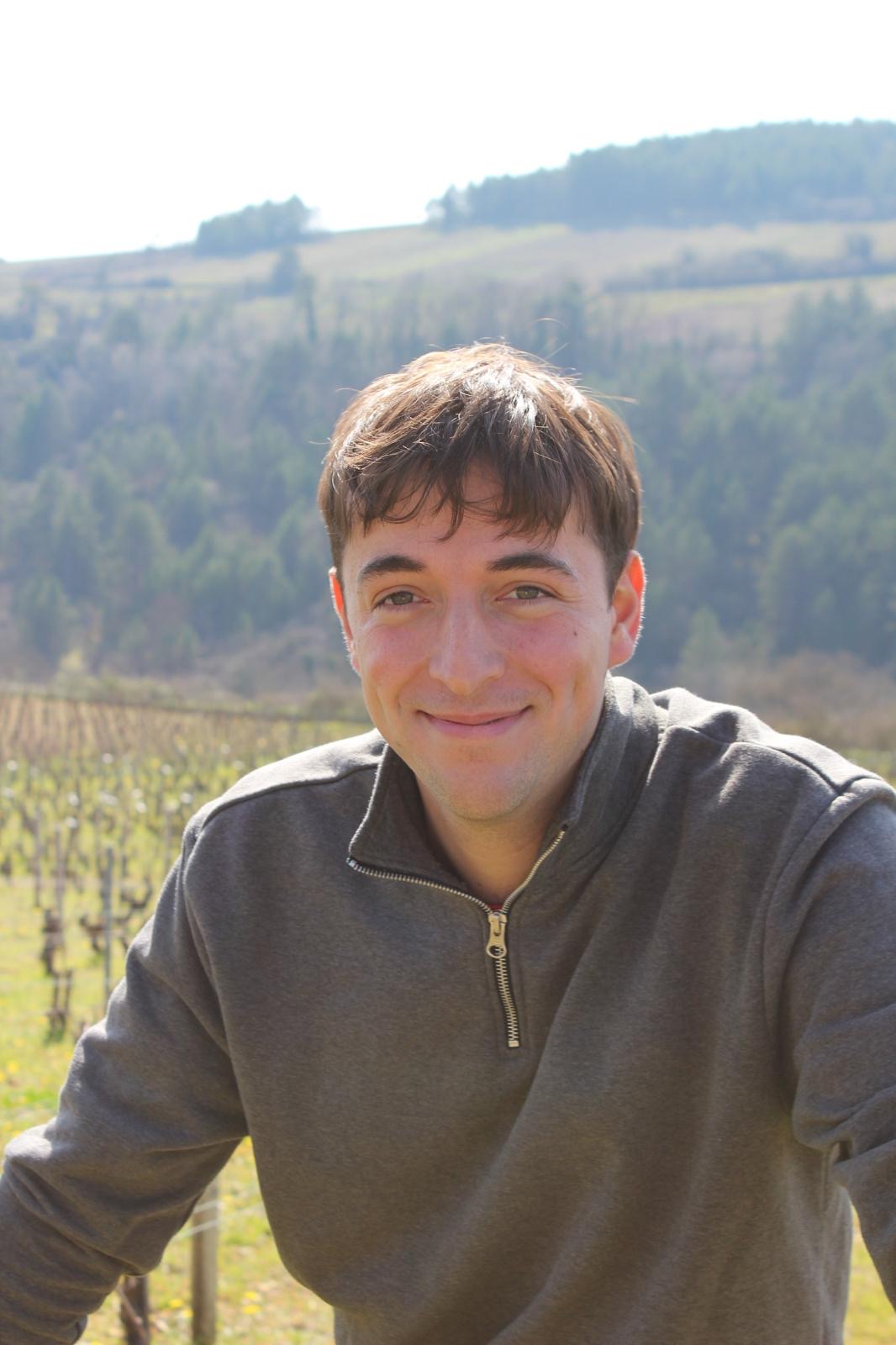
An unusual journey for this native of the Paris region, who began making wine from A to Z at the age of 14 and who now releases, together with his wife Lucile, their first four Burgundian cuvées thanks to the support of Athenaeum. In total, 2,292 freshly labelled bottles, ready to be distributed…
You were born in Clamart and you do not come from a family of winemakers… How on earth did you fall into wine?
Although I grew up in the Île-de-France region, all of my mother’s family comes from Burgundy. Better still, in 2001 my uncle bought a tiny plot of Pinot Noir there, Les Nargilets, north of Mercurey in the Côte Chalonnaise (19.70 ares). After entrusting its management to the local cooperative, he decided in 2008 to take care of it himself. That same year I began helping with the harvest, at the age of six, and eight years later I vinified my first vintage on my own. It was a generic red Bourgogne, mainly intended for my family and friends, for many years. Things changed when I entered the Dijon business school and took advantage of two gap years to train at Jacques Prieur in Meursault and, above all, at Keller, one of Germany’s three greatest winemakers. There, in 2021, during a blind tasting, Klaus-Peter Keller became enthusiastic about my 2017 Pinot Noir — so much so that he devoted a post to it. Barely two hours later, more than 150 sommeliers, importers and private buyers had contacted me. My entire stock was sold: four vintages, from 2015 to 2019!
And where does Athenaeum fit into all this?
Once again, Germany set the pace! By a lucky coincidence, Athenaeum’s best customer happens to be… German. After hearing about my wines, he naturally turned to the wine-bookshop in Beaune.
From there to supporting you…
Yet it happened quite naturally, in an atmosphere of trust. After spending years exploring the vineyard in search of young talents, Athenaeum wanted to go further by actively supporting a young winemaker. Together with Pierrick Muller, the former head of the shop’s cellar and now an importer in Singapore, Athenaeum created a small structure designed to provide financial backing for the talents of tomorrow. In practical terms, they finance my grape purchases, my first rents, and so on. In return, I grant them an almost exclusive role in the distribution of my wines, while retaining full control over how the business is run. It’s a win-win arrangement — everyone benefits.
What exactly is your approach?
Broadly speaking, I like light wines, with gentle extraction and soft infusion, marked by lively acidity. Rather than power, I seek elegance above all. In that respect, I think my time in Germany influenced me quite strongly. In fact, more than 50% of the wines in my personal cellar come from there. And yet, if I am completely honest with you, the two most striking tasting experiences I have ever had remain a Chevalier-Montrachet from Jacques Prieur and a highly animal Taurasi.
What does this philosophy imply when buying grapes?
I prioritise old vines over 30 years old — that is a prerequisite for the reds — ideally farmed organically and with controlled yields: never more than six to eight bunches per vine. Since I extract very gently, the grapes must naturally be fairly concentrated and display good complexity. Based on these principles, the 2024 vintage is released in four cuvées: Bourgogne Aligoté, Fixin, Pommard and Beaune 1er Cru, “Les Epenotes”. It is the ideal balance between affordability and my own stylistic approach. As I make all my reds in the same way, having vineyards with different terroir profiles suits me perfectly.
And in terms of vinification?
The full expression of the grapes guides me. In practice, I vinify alternating batches of whole, intact clusters and lightly crushed ones. For me, the stalks are the salt of the wine! This is followed by a fairly short vatting period — 10 to 15 days — without punch-downs, but with pump-overs, always with that same philosophy of gentle infusion. Next come vertical pressing, the blending of free-run and press juices, and ageing for 16 months. The ageing is deliberately very reductive — I keep more lees in my barrels than most colleagues — and always in old Riesling or Bourgogne Aligoté barrels. I find it brings brightness and freshness. That’s for the reds. The white wine, on the other hand, is a real outlier. The vintage was particularly challenging. I chose, among other things, to co-ferment with Pommard pomace to add colour and aromatic complexity. The result? A rosé Bourgogne Aligoté. A very singular wine for this vintage.
So overall there are very few additives…
Indeed. On the one hand, I only use indigenous yeasts; on the other, in a more traditional way, I add sulphur in three stages: a moderate dose at vatting, then very small doses after malolactic fermentation and before bottling — about 18 mg per litre. That combination is a bit of my signature. I believe it refines the aromatic profile while ensuring a certain longevity. I like the idea that my wines can wait for special occasions before being opened.
What does the future hold?
The 2025 vintage is already in the cellar. It includes seven cuvées: in white, a Bourgogne Aligoté “Sous les Roches” and a Pernand-Vergelesses “Les Belles Filles”; and on the red side, my Fixin and Pommard, joined by a generic Bourgogne, a Beaune 1er Cru “Les Montrevenots” and a Savigny 1er Cru “Les Lavières”. In every case the grapes were splendid. I’m extremely enthusiastic about it. As for what comes next, we shall see. I’m starting to look for vineyard leases. My potential clients tend to favour growers rather than négociants. Being able, in the near future, to run an estate from A to Z would be the ideal situation.